Why September Is the Best Month to Start a Weekend Tradition
How to start a weekend tradition with your partner that survives October. September gets you the first weekend. Design gets you the rest.
Read more →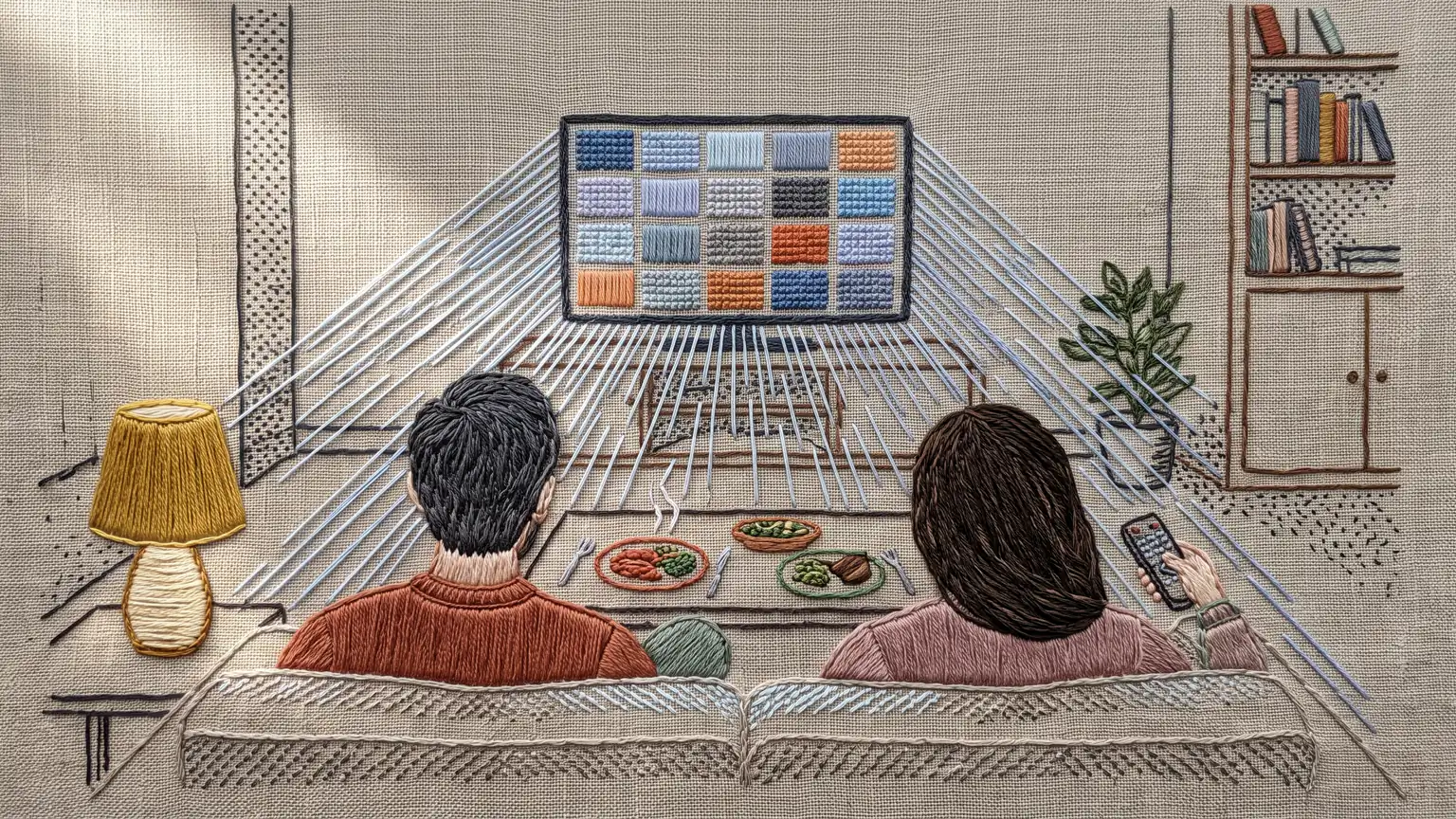
It's eight-forty. The food you actually made an effort with is going lukewarm on the coffee table. You've been through one app, drifted to another, come back to the first, and read the same four-line synopsis twice without taking in a single word of it. Somewhere around minute nine one of you says "just pick something," which isn't a real offer, and the other says "I don't mind, you choose," which isn't a real answer. By the time anything starts playing you're both faintly irritated, and it isn't about the film.
You're not unusually bad at this. Nielsen's 2025 State of Play report puts the average US viewer at twelve minutes per session just deciding what to watch — up from ten and a half two years earlier — and found that one viewer in five abandons the session entirely rather than keep looking. Nearly half describe the whole streaming experience as overwhelming. It's an industry survey rather than a study, and the company behind it sells content-discovery tools, so hold the decimal places loosely. The shape of it will feel familiar enough.
Here's what's worth noticing: none of that is a taste problem. You don't need better films. Almost everything written about movie night tries to optimize the hundred minutes in the middle — the pick, the snacks, the blanket, the lighting. But the part that goes wrong is the ten minutes before, and the part that gets thrown away is the ten minutes after, when you both say "that was good" and go brush your teeth.
Fix those two ends and the middle mostly takes care of itself. What follows is five moves for turning movie night into a ritual instead of a default — the thing you look forward to on Wednesday, not the thing you settle for on Saturday.
The scroll isn't indecision. It's negotiation. Two people each trying to guess what the other will tolerate while carefully claiming to have no preferences — which is the least efficient method humans have ever devised for choosing anything. Nobody wants to be the one who picked the film that turned out to be a slog, so nobody picks, and the algorithm fills the silence with thumbnails.
So take the negotiation out. Not what are we watching — whose turn is it. Settle it before the weekend, when neither of you is hungry and the couch isn't involved. Then let the person whose turn it is genuinely choose: no committee, no veto, no "hmm, what else is there." The other person's job is simply to show up generously, which is much easier than it sounds once you know your turn is coming.
This does something quietly good beyond saving twelve minutes. If one of you has slid into being the default chooser — not by agreement, just by drift — and the other has mostly stopped offering opinions, a rotation puts the quieter one back in the room. It also means you'll occasionally watch something you'd never have landed on yourself, which is most of the point.
Make it yours: Decide the rotation on a weeknight, not on the night. Whoever picks, picks — the other person doesn't get a vote, only a turn.
This is the part every other guide covers at length, so here it is briefly.
Phones out of reach — not face-down on the arm of the couch, actually across the room. Half-watching is the real enemy here: if one of you is scrolling through the second act, you're not watching together, you're sitting near each other while a film happens. Make the snacks something you had to do more than open. Turn the overhead light off. Start it at a time you can both stay awake for, which for most people is earlier than they think.
None of that is about aesthetics. It's about signaling to yourselves that this is a thing you're doing, rather than something that happened while the evening ran out.
Make it yours: Pick the one rule you'd both actually keep — phones in the other room, or no starting after ten — and keep only that one.
A theme solves the blank-page problem before it starts. Instead of choosing from everything ever made, you're choosing from a shelf.
Run a decade — everything from the years you were both in school, or the year you met. Do a double feature and pair two films that argue with each other. Watch the thing one of you loved as a teenager and the other has never seen, which is less about the film than about being shown something. Pick a country you want to travel to and watch your way there first.
The shape matters more than the specific choice. A theme gives the night a title, and a night with a title is a night you'll remember in a way that "we watched something on Saturday" never is.
Make it yours: Let whoever's turn it is choose the theme, and the other person choose the snack that goes with it.
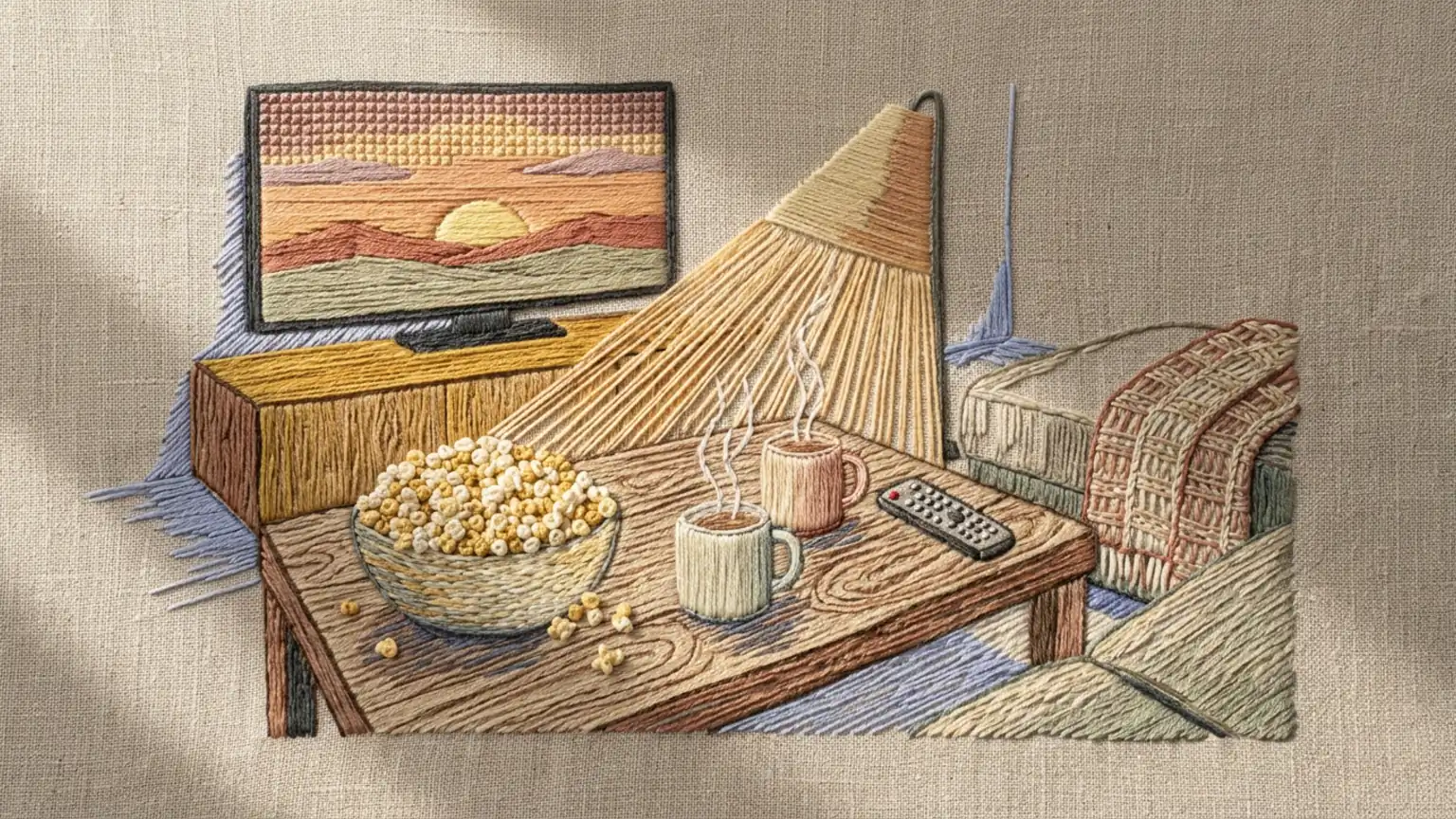
There's a quiet snobbery about re-watching — as though it's what you do when you've run out of imagination. It isn't. A film you both already know is a completely different pleasure from a new one, and on a lot of weeks it's the better one.
The stakes are gone. You know it's good, so there's no gamble and no forty minutes of waiting to find out whether this was a mistake. You can talk over the bits you both know are coming. You can put it on at the end of a week that took everything out of you, when the honest truth is that neither of you has the capacity for something demanding and subtitled. That's not settling — that's picking correctly for the state you're actually in.
There's even research on this, aimed for once at the tired rather than the virtuous. A 2014 study in the Journal of Communication looked at how nearly five hundred people used film and TV to recover from draining workdays. The recovery was real — an evening in front of a screen genuinely restored people — with one catch: those who filed the evening under procrastination felt guilty, and the guilt ate most of the benefit. Same couch, same film, same exhaustion; the difference was whether the evening counted as a choice or a lapse. So naming it — this is movie night, this is what we're doing — isn't decoration. It's what lets the easy night actually do its job.
And re-watching together does something new films can't: you're not just watching the film, you're watching it again, with everything that's happened to you since the last time. The one you saw early on, before you lived together, plays differently now. That's worth a Saturday on its own.
It helps to know, going in, which of the two kinds of movie night you're having. One is for something new, with room for a conversation after it. The other is for the film you already know, precisely because nothing will be asked of you. Both count. A lot of flat movie nights are just one kind being asked to do the other's job.
Make it yours: Each of you names the film you'd happily watch every year. Those two are your standing fallback for the weeks when nobody has the energy to choose.
Every other guide treats the credits as the finish line. Yet the one time movie night got a serious randomized trial, the talking afterward was the entire design.
In 2013, researchers at Rochester and UCLA followed 174 couples — all engaged or newly married — for three years. Some went through PREP or CARE, intensive therapist-led programs, the kind that run for weeks. The last group got a single afternoon workshop, then a list of films about relationships and a set of discussion questions to take home: one film a week for a month, with about forty-five minutes of real conversation after each.
Three years on, the couples who'd done none of it had split at roughly twice the rate of those who'd completed a program — 24 percent against 11. Hold those numbers the way you held Nielsen's: the no-treatment group wasn't randomly assigned, and couples who complete programs are, by definition, couples who finish things. The finding that survives every caveat is the more interesting one anyway. The movie couples matched the professionals. Three years out, there was no measurable difference — in breakups or in satisfaction — between a month of films at home and fifteen hours of expert-led skills training.
Which points straight at the active ingredient. The two therapy programs never used a film; the film couples were never taught a skill; all three worked equally well. The one thing every version shared was a couple giving their own relationship regular, undistracted attention — or, as the study's lead author put it, couples "taking a cold hard look at their own behavior." The films were the excuse. The conversation was the work.
You don't need their films or their questions, though both are freely available if you want them. What's worth stealing is the shape: watch it, then actually talk about it, and give it more than ninety seconds. Not film criticism — the interesting questions are the ones about you. Which of them did you understand? Would we have handled that the way they did? What did you want to happen, and what does it say that you wanted it?
The thing that makes this stick, rather than staying a good intention, is keeping some record of it. Give the night a verdict — did you both like it or not — and jot down what you said. What you get, a year on, is a shelf of nights you can actually point at: the ones you both loved, the ones only one of you did, the argument you had about the ending. That's a shared history, and it accumulates faster than you'd expect.
And some nights earn a pass. If tonight was the recovery kind, let the credits roll and say nothing — a ritual survives a quiet night far better than it survives a forced conversation.
Make it yours: Ask one question before either of you reaches for a phone. "What did you think?" doesn't count — pick something the film actually raised.
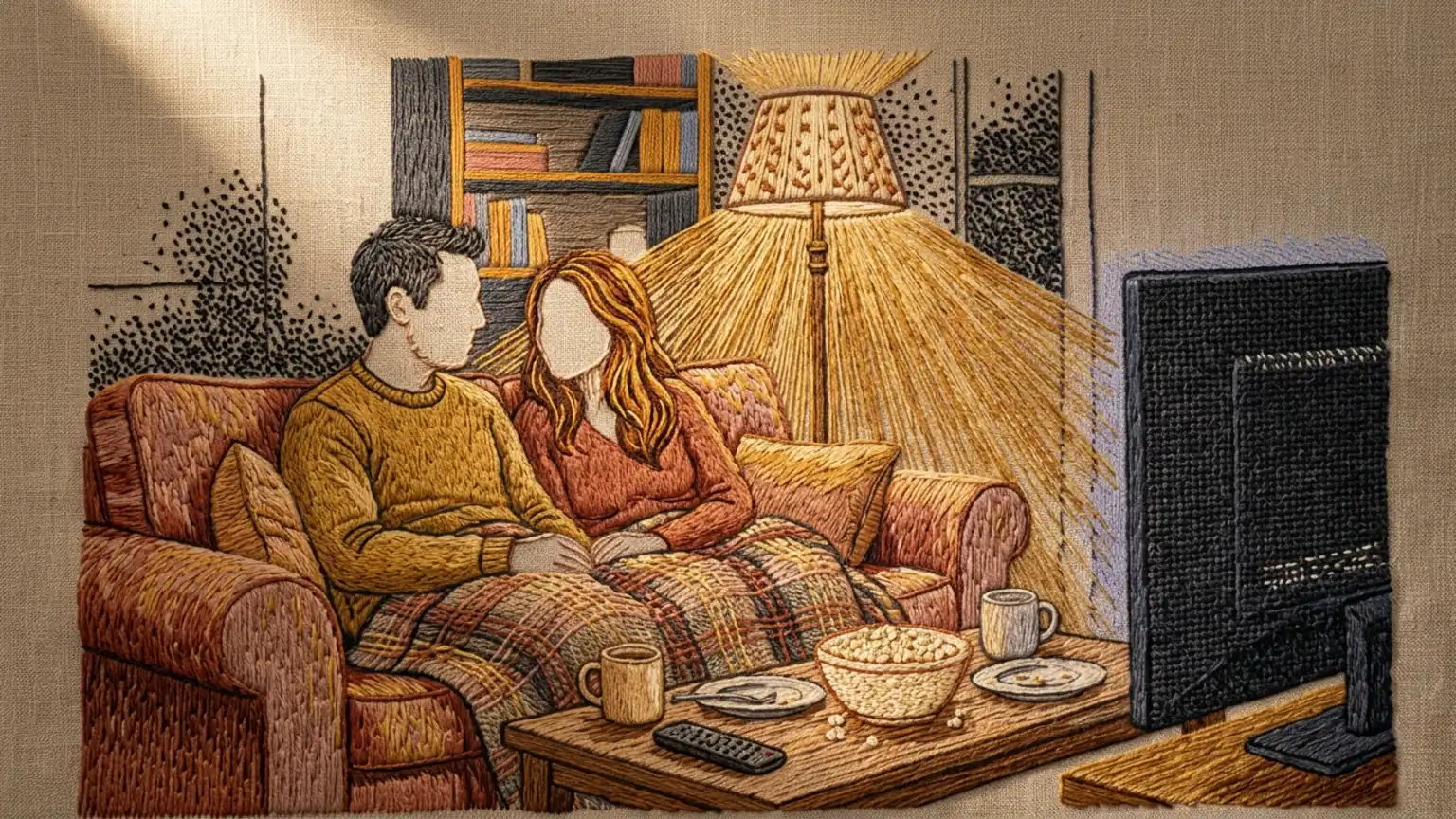
A ritual is only a good intention with a mechanic attached. The intention here is easy — everyone wants a standing night in with the person they live with. What kills it is that nothing decides whose turn it is, nothing remembers the film you meant to watch six weeks ago, and nothing survives a busy couple of weeks.
That's the part Saturday Plans handles. Make an activity for movie night, set it to one pick per turn, and choose who goes first. Both of you can drop films into the shared bag whenever you think of one — adding is always open, it's only choosing that alternates. When you've watched it, mark it done and the turn passes to the other person on its own. You each give it a thumbs up or down separately, and the ones you both liked come back marked as exactly that, next to your own notes on the night. Set it to run weekly or every other week and the rotation keeps itself.
Do that for a few months and it stops being a plan and becomes a ritual — the same way a standing Friday walk does, or an afternoon spent exploring your own city when you'd rather be out than in.
Decide whose turn it is before Friday. Then, when the credits roll, stay on the couch for ten more minutes.
Ready to plan your next weekend together?
Get Started
How to start a weekend tradition with your partner that survives October. September gets you the first weekend. Design gets you the rest.
Read more →
The best adventure this weekend might be the city you already live in. Five ways to be a tourist in your own town, together — no trip required.
Read more →
Summer date ideas sorted by what they cost: free, under $50, the rare splurge. Plus the one move that turns a saved list into a real Saturday.
Read more →